

Service
Garage door opener repair and installation
When the opener runs but the door stays put, the opener is usually not the part that failed.
What happens
What is actually going on
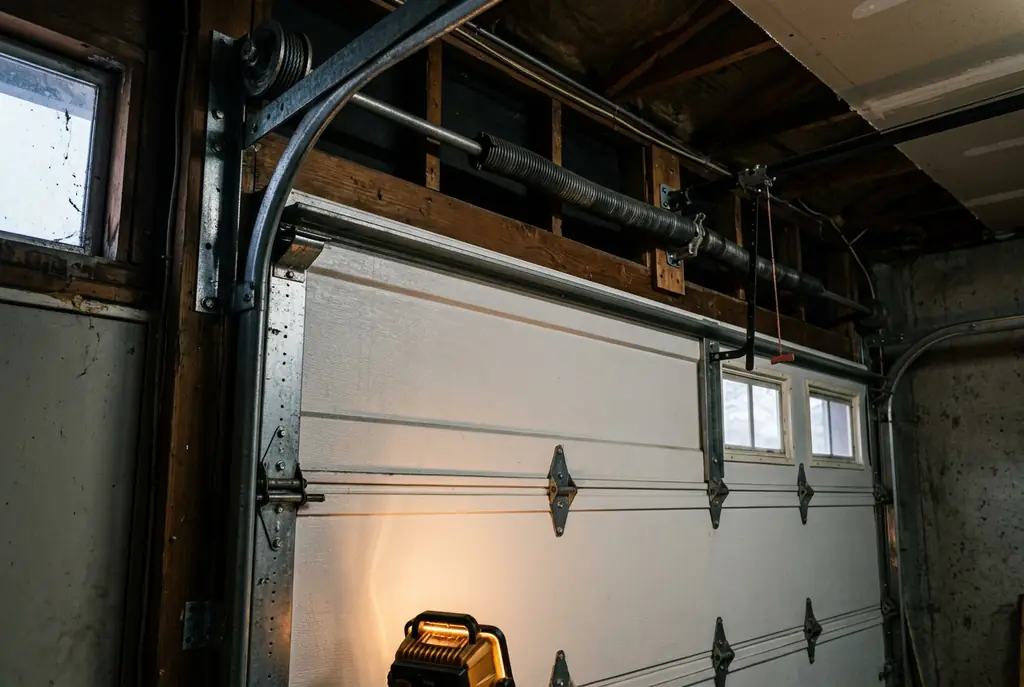
An opener is a small motor. It is not designed to lift a garage door — it is designed to guide a door that the springs have already made almost weightless. So when an opener appears to fail, the honest first question is whether the door became too heavy for it, which points at the springs rather than the motor.
When the opener genuinely is the problem, it is usually one of a few parts: a stripped nylon drive gear, a worn trolley or carriage, a failed logic board, or safety sensors knocked out of alignment. Since 1 January 1993, US federal law has required residential openers to have an automatic reversing mechanism plus photo-eye sensors or edge sensors, so every opener you are likely to own has a pair of sensors near the floor that will stop the door if they cannot see each other.
Belt drives run quietly and suit garages with a bedroom above them. Chain drives cost less and are louder. Wall-mounted jackshaft units mount beside the door instead of on the ceiling, which is worth knowing if you want the ceiling clear for storage.
Signs
What you would notice
- The motor hums or runs but the door does not move
- The door starts down then reverses back up on its own
- The remote works but the wall button does not, or the reverse
- Grinding from the motor housing, sometimes with plastic shavings below it
- The door only closes if you hold the wall button down
- The opener light blinks in a repeating pattern
What we do
What the visit involves
- Disconnect the opener and test the door by hand first. A balanced door will hold at the halfway point on its own — if it slams or flies up, the problem is the springs, not the opener.
- Check the safety sensors for alignment, obstruction and a solid indicator light.
- Inspect the drive gear, trolley and rail for wear.
- Repair where the unit is worth repairing, and say so plainly when it is not.
- Reset force and travel limits, then test the safety reverse before leaving.
What it costs
Priced before the work starts
You get the number before we begin, not after. What moves it is the size of the door, the parts it needs, and whether anything else came apart when the first thing failed.
Price bands pending client sign-off
Published bands must be Gold Shield’s own pricing rather than market averages, so nothing is shown yet.
Questions
What people ask
- The door reverses before it touches the floor. Why?
- Usually the close-force or travel limit is set wrong, or the safety sensors are misaligned. The opener thinks it has hit something. It is normally an adjustment rather than a new opener.
- Is my opener worth repairing or should I replace it?
- A stripped gear or a bad sensor on an otherwise sound unit is worth repairing. If the logic board has failed on an opener already past ten years old, replacement is usually the better spend. We will tell you which one you are looking at before doing the work.
- Which is quieter, belt or chain?
- Belt, noticeably. If there is a bedroom or living space directly above the garage, that difference is the whole decision. A wall-mounted jackshaft unit is quieter again and keeps the ceiling clear.
- My remote stopped working but the wall button is fine.
- Start with the remote battery, then reprogramming. If neither fixes it, the receiver in the opener head is the next suspect.
Where we work
Service area
Northwest suburbs
- Schaumburg
- Hoffman Estates
- Roselle
- Streamwood
- Hanover Park
- Elk Grove Village
- Rolling Meadows
- Palatine
- Bloomingdale
- Itasca
- Bartlett
- Arlington Heights
- Mount Prospect
- Des Plaines
Northwest Chicago
- Portage Park
- Jefferson Park
- Norwood Park
- Edison Park
- Dunning
- Irving Park
Get a time
Tell us what the door is doing
Same-day service across the northwest suburbs and northwest Chicago. If we cannot get to you today we will say so on the phone.
Call (407) 874-7717